This page includes previous posts to the website, many of which contain references to resources that may be of use and/or interest to users
Chris Penny – a personal tribute

It was with the utmost sorrow that I learned of Chris’s death on 19 November. Although we had not seen each other in person recently, in this post-Covid world, we had been periodically in touch via email to exchange news and views on topics of mutual interest relating to the University of Birmingham and special collections in general.
Our last two contacts over the summer were when Chris sent me greetings on my birthday, as she had always done in recent years (she had a fantastic memory), and when Chris broke the news of the return of her illness, a burden which she had accepted with such grace and carried with such fortitude.
I first met Chris in 1990, when I came to the University of Birmingham as Deputy Librarian. Chris was a valued member of the (then) very small special collections team. She had joined the University as University Archivist in 1971, after her first professional post as Assistant Librarian at the Shakespeare Birthplace Trust from 1967 to 1971.
For the remainder of my time at Birmingham, until 2001, Chris proved to be an indefatigable ally in building up and promoting the University’s special collections department, extending its accommodation, increasing its staffing, growing its collections, automating archival cataloguing, and overseeing a campus-wide modern records management programme. A particular highlight in the mid to late 1990s was Chris’s immense contribution to the University’s considerable success in bidding for grants from the higher education funding councils’ institutionally-based Non-Formula Funding of Special Collections in the Humanities and the subsequent consortially-based Research Support Libraries Programme.
On the retirement of the then Head of Special Collections, the University had absolutely no hesitation in appointing Chris as his successor in 1995. She held that role, combining it with University Archivist, with considerable distinction until her own retirement in 2005, also engaging energetically with regional and national special collections colleagues. In 2007, when I was invited to be President of the Religious Archives Group, I found myself working closely with Chris again. She had been involved in RAG from its beginnings, serving as a member of its committee since 1991 and its treasurer since 1993, the latter role also entailing considerable administrative support for the annual RAG conferences. During my time as RAG President and committee member, she was an enormous help in facilitating the committee’s ambitions for enhancing RAG’s profile and value to religious archives and their users. She was centrally involved in securing small charity status for RAG and establishing its small grants programme.
Retirement saw no let-up in Chris’s devotion to special collections. Besides her service to RAG, she was treasurer of the Historic Libraries Forum for many years. She was a freelance cataloguer of rare books for the National Trust. She was a member of Hereford Cathedral library Committee and honorary consultant to Worcester and Lichfield Cathedral libraries. In later years, an increasing proportion of her time was devoted to the Hurd Library at Hartlebury Castle, a neglected late eighteenth-century gem. It was her passion. Chris was formally designated Hurd Librarian in 2009. She promoted the library through tours, talks, and research and fought tirelessly for a securer future for it and the Hartlebury estate. For those unfamiliar with the Hurd Library, Chris’s various articles about it are well worth reading. The easiest to access are probably those in The Book Collector, vol. 60, no. 3 (2011), Library and Information History, vol. 32, nos. 1–2 (2016), and, especially, in Princes of the Church: Bishops and their Palaces, edited by David Rollason (2017).
Chris was a consummate professional, with deep technical and subject expertise and a wide circle of contacts. She was a caring manager of staff and a person of the highest integrity. She was unfailingly courteous and helpful to users, receiving much positive feedback from them. She was undoubtedly one of the finest UK special collections librarians of her generation. I shall miss her greatly, both as a person and professional, and for her wisdom and campaigning zeal. However, I shall be uplifted by the legacy she leaves us and by the privilege of having known her.
Clive Field
President of Religious Archives Group, 2007–16
8 December 2023
Quaker strongrooms
Since the start of the year Quaker Strongrooms, the archives blog of the Library of the Religious Society of Friends, has been featuring the rich World War One resources held by the archives.
It is well worth visiting, here.
This entry was posted in British Religious History, Religious Archives and tagged Quakers, World War One on by Tim Powell. Edit
Muslim soldiers in World War One
The Everyday Muslim project has featured a number of projects in its contribution to Explore Your Archive 2014. It includes an exciting Birmingham HLF project , We Also Served,
“More than 430,000 Muslims of South Asian origin joined the British Army between 1914 and 1918, after which many relocated to Britain. We Also Served, a project led by Xtra Mile West Midlands (XMWM), will focus on the lives and service of those who settled in Birmingham and the impact their involvement had on their descendants still living in the city.”
This entry was posted in British Religious History, Religious Archives and tagged Everyday Muslim project, Muslims, World War One on by Tim Powell. Edit
Archives and record-keeping in the United Church of Canada
The United Church of Canada has webpages devoted to archives and records guidance for congregations and conferences, research resources, and links to its network of archival repositories.
http://www.united-church.ca/local/archivesThis entry was posted in British Religious History, Religious Archives and tagged archives, Canada, records management on by Tim Powell. Edit
Extracts from World War One War Diary
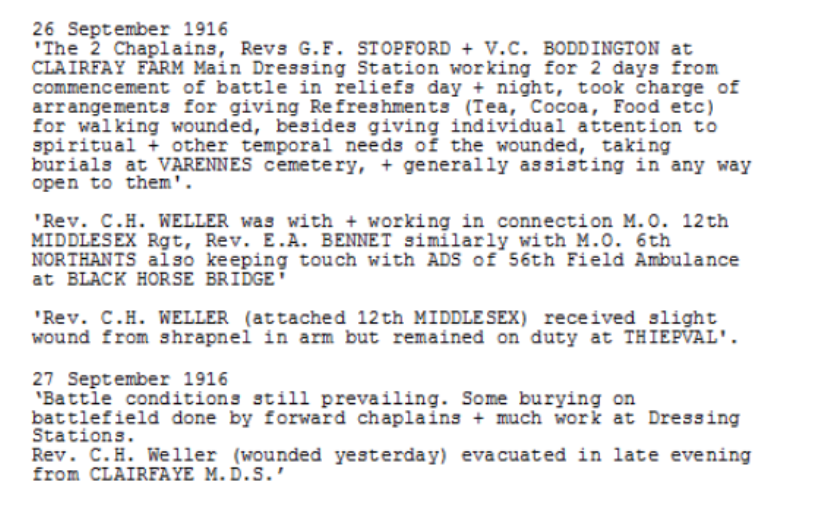
Further extracts from the official War Diary of Revd G.A. Weston, Senior Chaplain to the 18th Division on the Western Front, August-November 1916 (held at The National Archives, reference WO 95/2023 (4)). These entries relate to the outbreak of the Battle of Thiepval Ridge.
This entry was posted in British Religious History, Religious Archives on by Tim Powell. Edit
Extracts from World War One War Diary
Further extracts from the official War Diary of Revd G.A. Weston, Senior Chaplain to the 18th Division on the Western Front, August-November 1916 (held at The National Archives, reference WO 95/2023 (4)).

This entry was posted in British Religious History, Religious Archives on by Tim Powell. Edit
Extracts from World War One War Diary
For the next few days up to 11 November this blog will feature extracts from the official War Diary of Revd G.A. Weston, Senior Chaplain to the 18th Division on the Western Front, August-November 1916 (held at The National Archives, reference WO 95/2023 (4)). It records events up to, during and after the Battle of Thiepval Ridge and the subsequent Battle of the Ancre, two of the final actions of the Battle of the Somme

Notes
Battle of Thiepval Ridge and Battle of the Ancre
http://en.wikipedia.org/wiki/Battle_of_Thiepval_Ridge
http://en.wikipedia.org/wiki/Battle_of_the_Ancre
Revd Edward Armstrong Bennet M.C. (1888-1977)
Bennet was born in Poyntzpass, near Armagh. He studied philosophy and theology at Trinity College, Dublin and after further studies at Ridley Hall, Cambridge, was ordained in the Church of England. At the outbreak of the First War he joined the 6th Northants Regiment as their chaplain, and in 1915 he was awarded the Military Cross. The experiences of the war led him to return to Trinity College where he qualified in medicine in 1925. From the start of his medical career Bennet’s interest lay in psychiatry. He was later a friend and biographer of Gustav Jung.
http://www.daimon.ch/catalog/index.php?manufacturers_id=12
Revd Vincent Coke Boddington (1886-1917)
Boddington was appointed Chaplain 4th Class attached to 35th General Hospital, Royal Army Medical Corps. He died on 13 March 1917.
Revd Ronald Douglas Canadine (1887-1960)
After his First World War service Canadine served as a Chaplain in the Royal Navy from 1921. He was later Rector of Alvescot 1937-1945.
Revd Charles Tasman Parkinson (1886-1968)
Parkinson, was born at Hawera, New Zealand. He was educated at Wellington College and Auckland University College. In 1906 he entered Christ Church, Oxford. After studying theology he was ordained in 1912. As a curate at South Shields, Durham, for the next three years he worked among Tyneside pitmen and shipyard workers. In 1916-1918 Parkinson served with various units in France and Belgium as a chaplain. In July 1918 he resigned his chaplaincy, re-enlisted as a gunner on 22 August, and served in France until the Armistice. After the war, Parkinson accepted a position at Christ’s Hospital, Horsham, Sussex. In 1932 Parkinson was appointed headmaster of The King’s School, Parramatta, New South Wales. During World War II he returned to Sydney to serve as assistant priest at St Jude’s, Randwick, until 1946.
Revd Grosvenor Francis Stopford (1889-1949)
After his war service Stopford served at Holy Trinity, Bradford, Yorkshire. In the Second World War, he returned to military chaplaincy as Deputy Assistant Chaplain-General 1940-1944. He was then Rector at Frethherne, Gloucestershire, 1945-1949.
Revd Christopher Harold Weller M.C. (1879-1960)
After service on the staff of St. Mary’s, Nottingham, Weller became Vicar of Great Longstone, Derbyshire. He was then Vicar in 1929 of All Saints, Nottingham 1929-1937, and Rector of All Hallows, Gedling, 1937-1948; he was later made a Canon of Southwell. His MC citation is recorded here:
Revd George Antipas Weston (1877-1953)
After missionary service, Weston was Vice-Principal of Lichfield Theological College from 1912 to 1920, during which period he served as Senior Chaplain to the 18th Division. He was later Vicar of Fleetwood 1920-1926, St Mary, Nelson 1926-1932, and Lynton 1932-1945. In 1945 he was appointed to the living of living of Leusdon, Devon.
This entry was posted in British Religious History, Religious Archives and tagged archives, Military chaplains, World War One on by Tim Powell. Edit
Mercy in World War One
This is the title of an exhibition hosted jointly by the Institute of Our Lady of Mercy (Bermondsey, London) and the Union of the Sisters of Mercy GB (Handsworth, Birmingham).

The exhibition looks at how the war was experienced by the SIsters of Mercy, their efforts on the Home Front and the work of Catholic military chaplains.
More at http://www.sistersofmercyunion.org.uk/news/fx-articles.cfm?loadref=26&id=202
This entry was posted in British Religious History, Religious Archives and tagged Sisters of Mercy, World War One on by Tim Powell. Edit
Empire, Faith and War: The Sikhs and World War One
A fascinating exhibition on the contribution of Sikhs (and indeed the Indian Army more generally) to Britain’s war effort has just opened at the Brunei Gallery at the School of Oriental and African Studies. There is imaginative use of archives alongside a broad range of artefacts and audio-visual material.
It has been put together by the UK Punjab Heritage Association and runs to 28 September. For more information see
This entry was posted in British Religious History, Religious Archives and tagged Sikhs, World War One on by Tim Powell. Edit
Jesuit Chaplains of the Irish Province
The Irish Jesuit Archives in Dublin has an interesting Flickr site which includes a set of images commemorating the 32 Jesuit chaplains of the Irish Provice who served in World War One. It is here.
Four Jesuits were killed and two died from illness on active service. Additionally, ten Irish-born Jesuit chaplains of the English Province served in the war, two died on active service.
This entry was posted in British Religious History, Religious Archives on by Tim Powell. Edit
Lascars in World War One
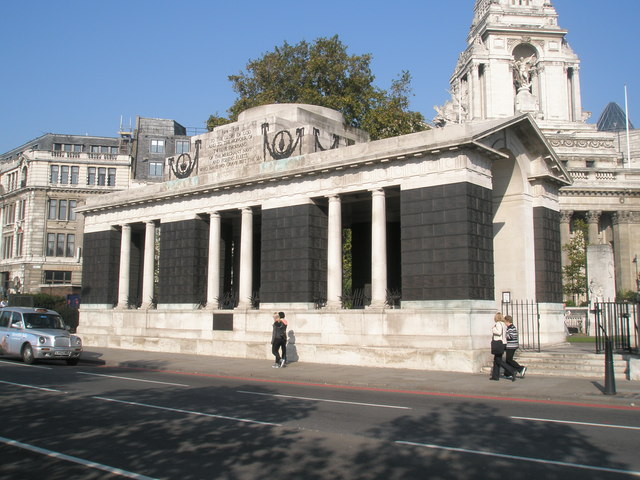
The Tower Hill Memorial to sailors of the Merchant Navy and fishing fleets. (Photograph copyright Basher Eyre)
The contribution of South Asians to the war effort, particularly the Lascars, who served in large numbers in the Merchant Navy, is highlighted in this blog from the Everyday Muslim project in East London.

This entry was posted in British Religious History, Religious Archives and tagged Everyday Muslim project, Lascars, World War One on by Tim Powell. Edit
World War One at Lambeth Palace Library
Lambeth Palace Library holds considerable archival material relating to the First World War, and to highlight these resources it has produced a Research Guide. The largest body of material is to be found in the papers of Archbishop Davidson, and it covers a huge range of topics, from agricultural work on Sundays to the wartime role of the Church Lads’ Brigade.
The Guide is at http://www.lambethpalacelibrary.org/files/first_world_war.pdf
In the coming months Lambeth Palace Library will highlight items from the collections on its blog
http://lambethpalacelibrary.wordpress.com/
This entry was posted in British Religious History, Religious Archives on by Tim Powell. Edit
Propaganda and Islam: from The National Archives
The entry of the Ottoman Empire into the war in November 1914 posed a great danger for the Allies. Both Britain and France had empires with substantial Muslim populations and important supply routes and strategic interests were potentially threatened. The declaration of a jihad against the Allies raised the possibility of mass insurrection.
No such insurrection occurred. Muslim leaders in French Africa and in the British Empire issued statements of loyalty and the French Government, seeing the propaganda value in publicizing these more widely, published those from West Africa, Algeria, Tunis and Morocco in volume 29 of the Revue du Monde Musulman (December 1914). In June 1916, the British Government discussed issuing a propaganda volume containing assurances of loyalty from Muslims in Nigeria, the Malay States, Sierra Leone, East Africa and so on (The National Archives, CO 323/719, 520-522) .
However, such statements were not to be relied upon. A note of caution was added to the file.

At about the same time, the British War and Colonial Offices were considering how to use a document that, it was claimed, had been captured by General Smuts’ forces at Moshi (German East Africa) in March 1916 (FO 141/666/2512). This was in the form of a directive, hostile to Islam, supposedly sent to District Commissioners by Dr Schnee, Governor of German East Africa, in winter 1913. The document included suggestions that circumcision be banned, preaching in Mosques prohibited and pig-breeding encouraged.
An Arabic translation by the British Directorate of Special Intelligence (MI7) was circulated in Egypt in May 1916 but, unsurprisingly, the British Residency reported back that ‘…in Egypt people generally have been unwilling to believe in its authenticity. They consider it as a fabrication – and not a very clever one’. The text was ‘corrected’ by T.E. Lawrence in June but there does not seem to have been any further attempt at general circulation.

This entry was posted in British Religious History, Religious Archives and tagged World War One on by Tim Powell. Edit
How to start a church archive
Looking at useful religious archives advice from outside the UK, there is helpful advice for starting to create a congregational archive at the Southern Baptist Convention Historical Library and Archive website http://www.sbhla.org/articles.htm
Although intended for a US and Baptist audience, much of the advice is more widely applicable.This entry was posted in British Religious History, Religious Archives on by Tim Powell. Edit
Letters from the Western Front
“Socks are in great demand when the weather is bad and mud is everywhere, and the mitts and woollen headgear are desirable if not essential, when the weather is cold”, Private R.V. Palmer
The Archive of the Month of the Church of Ireland Representative Church Body Library in Dublin for December 2012 tells the story of letters from the Western Front received by Revd Arthur Barton, Rector of Dundela parish in Belfast, from parishioners serving in the Army who had received Christmas parcels through a parish scheme.
More at http://ireland.anglican.org/about/158

This entry was posted in British Religious History, Religious Archives on by Tim Powell. Edit
The Jewish Experience of War
A forthcoming exhibition at the Jewish Museum in London, ‘For King and Country?’ will present personal stories of the First World War, including those of some of the over 50,000 Jewish soldiers who fought for Britain, as well as those who experienced war away from the battlefield.

The exhibition opens on 19 March. For more information see
http://www.jewishmuseum.org.uk/kingandcountry
This entry was posted in British Religious History, Religious Archives and tagged Jewish Museum in London, Jews, World War One on by Tim Powell. Edit
Jewish Immigrants in Scotland during World War One
During the First World War, there were around 12,000 Jews in Scotland, many of them immigrants from the Russian Empire (mostly present-day Poland, Lithuania, Latvia, Belarus and Ukraine). The majority of the foreign-born Jews were not naturalised, and many of them had surnames which sounded at best foreign and at worst German or Austrian (indeed the British royal family at that time felt the need to change their name from Saxe-Coburg to Windsor). Foreign-born Jews were anxious to show that they were loyal to their adopted country and many served in the forces.
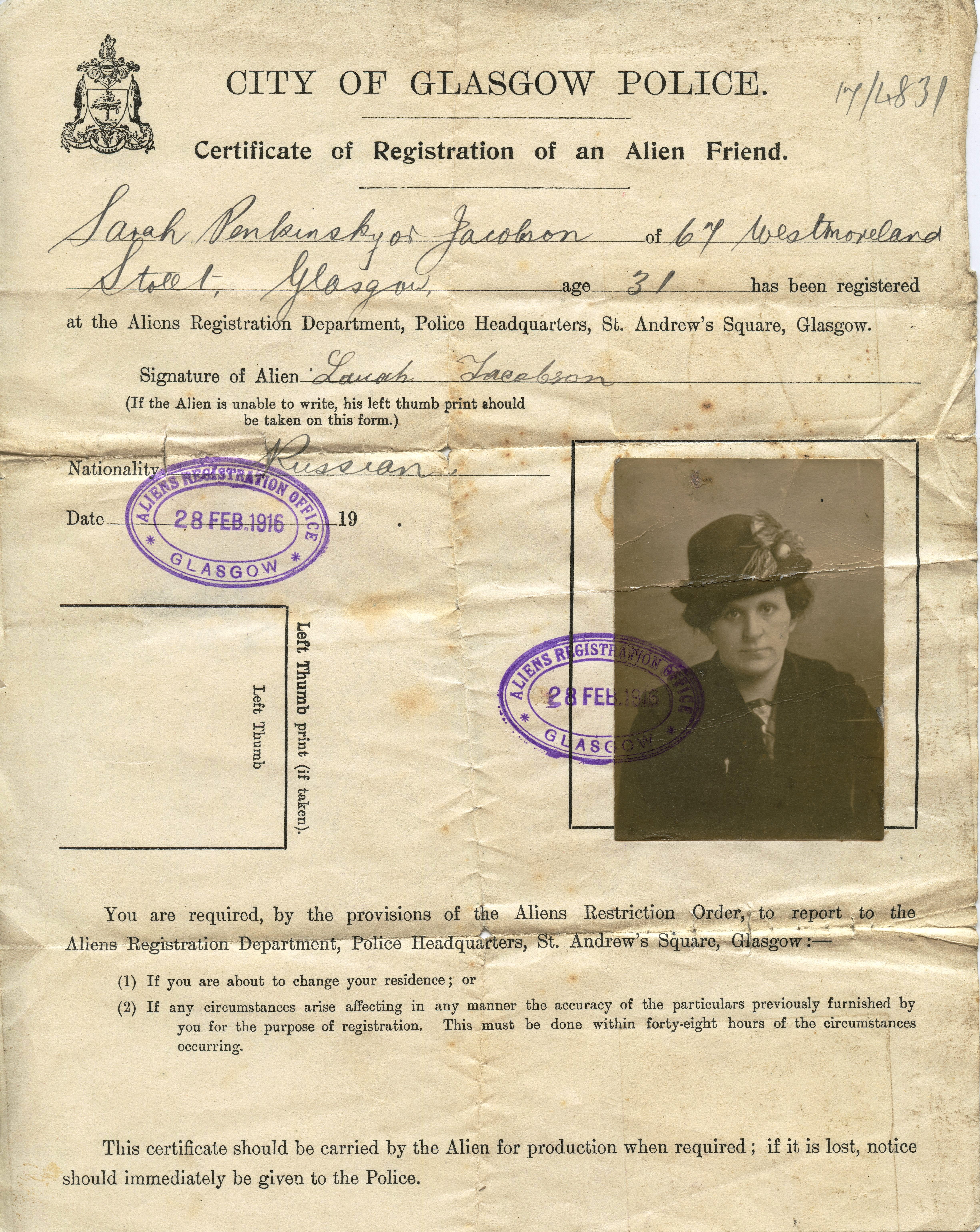
The Scottish Jewish Archives Centre has a collection of certificates issued to non-naturalised Jews to state that they were from a friendly country (Russia), rather than enemy Germany or Austria-Hungary. The documents were issued by the Glasgow Jewish Representative Council, City of Glasgow Police and the Imperial Russian Vice-Consulate.
(Harvey Kaplan, Director, Scottish Jewish Archives Centre. www.sjac.org.uk)
This entry was posted in British Religious History, Religious Archives and tagged Jews, Scotland, Scottish Jewish Archives, World War One on by Tim Powell. Edit
A torpedoed missionary
The Henry Martyn Centre blog has a World War One entry on Archdeacon Tom Dennis, translator of the Bible into Union Igbo (a Nigerian language). He went down when S.S. Karina was sunk by a German U-Boat in August 1917.
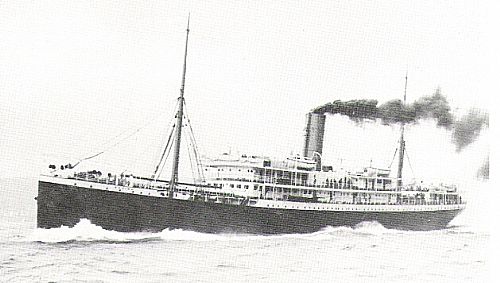
SS Karina, sunk 1 August 1917. Photo from E.D. Fleet History
http://www.clydesite.co.uk
This entry was posted in British Religious History, Religious Archives and tagged Henry Martyn Centre, Missionary, World War One on by Tim Powell. Edit
World War One in Religious Archives
The Imperial War Museum is heading the First World War partnership. The website www.1914.org highlights centenary events and resources from across the world.
Many religious institutions, including those holding archives, are included among the partner organisations.

This entry was posted in British Religious History, Religious Archives on by Tim Powell. Edit
Digital Religion
Digital Religion was the title of a conference held last year at the Center for Religion, Media and Culture at the University of Colorado, Boulder.
The pre-conference discussion paper suggested three ways of seeing the interplay between religion and digital media: the use of such media to convey traditional religious practices, the novel forms of religious life made possible by new technologies and, thirdly, a ‘large, fluid, and evolving category beyond these’ in which ideas of what is and what is not religion are being challenged and redefined.
The conference website, featuring presentations and other material, is being mounted online at https://www.colorado.edu/cmrc/2011/06/16/2012-international-conference-digital-religion. So far the plenary videos are available, that by Heidi Campbell of particular interest in highlighting the range of ways in which religion is conducted online.
Although the issue of how to capture and preserve these manifestations of faith was not a concern at the conference, the proceedings are a reminder of how even traditional aspects of religion are being affected and will potentially be transformed by digital technology.This entry was posted in British Religious History, Religious Archives and tagged Digital religion on by Tim Powell. Edit
Archives resources from New Zealand
One aim of this blog is to draw attention to relevant advice and guidance from outside the UK. This time, it’s from the Archives Research Centre of the Presbyterian Church of Aotearoa New Zealand at http://www.archives.presbyterian.org.nz/

The Centre has a pro-active archives collecting policy (http://www.presbyterian.org.nz/archives/collectionpolicy.pdf) and its website offers a number of useful resources, including a guide to records management for the parish and church organisations at http://www.presbyterian.org.nz/archives/recordsmanagement1.pdf
and a guide to archives management at http://www.archives.presbyterian.org.nz/whatarewetokeep.pdf
The introductory lines of the archives management guide summarize what archives can offer the church, and are worth quoting:
“Our parish archives are valuable and delicate documents:
they are strands of memory
they are collective memory
they help us converse with our Presbyterian past
they convey visions
they tell of hope
they tell us about the progression of faith in the community
they act as reminders where we have erred
they are important in charting a future of Christian witness“This entry was posted in British Religious History, Religious Archives and tagged collecting policy, New Zealand, Presbyterian, records management on by Tim Powell. Edit
New home for UK Baha’i archives?
Archives are central to the Bahá’í faith. The original writings (tablets) and letters of The Báb , Bahá’u’lláh and Abdu’l-Bahá are of profound spiritual importance and the faith has always attached significance to its historical records. Shoghi Effendi, its head from 1921 to 1957, noted,
‘The importance of the institution of Bahá’í Archives is not due only to the many teaching facilities it procures, but is essentially to be found in the vast amount of historical data and information it offers both to the present day administrators of the Cause, and to the Bahá’í historians of the future. The institution of Bahá’í Archives is indeed a most valuable storehouse of information regarding all aspects of the Faith, historical, administrative as well as doctrinal’
(From a letter to the National Spiritual Assembly of the United States and Canada, 25 September 1936)
American Bahá’ís have an impressive archive based in the House of Worship in Illinois https://www.bahai.us/category/house-of-worship/
The Bahá’í International Archives was first of the buildings to be erected in the Arc, the Bahá’í headquarters buildings in Haifa, Israel.
In the UK, documents relating to the  Bahá’í archives are homed at the Afnan Library. The library is based in a former Baptist chapel in Sandy, Bedfordshire.
The Afnan Library was established in the will of Hasan M. Balyuzi (1908-1980), an eminent scholar and a descendant of the Báb to be a central research resource for the Bahá’í faith in Britain. for more details see the Afnan Library web page https://afnanlibrary.org/This entry was posted in British Religious History, Religious Archives and tagged archives, Baha’i faith on by Tim Powell. Edit
Archives as a religious calling
Few religious organisations place archives quite as centrally to their mission as John Carver Ministries, based in Maryland. Their website notes, ‘In order to go forward, you must remember from whence you came. The heritage (what is handed down from one generation to the next; inheritance) of the past is the seed that brings forth the harvest of the future. If there is going to be a harvest of souls in the future, then we must preserve the events of the past. That is why an archives is so important.

(Published with permission of Healing and Revival Press, http://healingandrevival.com/)
John Carver Jr’s personal testimony, ‘How Did God Use Me to Develop the Faith Outreach Archives?’ recounts how God called him to seek out and rescue archives relating to previous pastors offering healing ministries, such as A.A. Allen,
‘Because so many ministers of the past failed to preserve their ministries, Faith Outreach Archives has become a record chamber to preserve the memory of our Christian heritage. In the interest of generations that will come after us, we are working to recall and store up the information that is an important witness of our past.
‘Proverbs 2:1-5 says, “My son if thou wilt receive my words, and hide my commandments with thee; so that thou incline thine ear unto wisdom, and apply thy heart to understanding; yea if thou criest after knowledge, and liftest up thy voice for understanding; if thou seekest her as silver, and searchest for her as for hid treasures; then shalt thou understand the fear of the Lord, and find the knowledge of God.” This scripture was the basis for my search for knowledge and has become the highlight of the Faith Outreach Archives.’This entry was posted in British Religious History, Religious Archives and tagged archives, John Carver Ministries on by Tim Powell. Edit

